

Vibe coding, AI Powered SDLC - Advantages & Misconceptions
How AI is transforming software creation without making software companies obsolete.

A few weeks ago, the CXO of a multi-million-dollar technology company reached out to me with an interesting ask.
His company relied on a long list of software products—Asana, Microsoft Office, Adobe Photoshop, TurboTax, LinkedIn Premium, and many others. Collectively, these subscriptions were costing the company millions of dollars each year. In fact, they were spending nearly $20 million annually on software subscriptions against an ARR of roughly $400 million.
His question was simple:
“With tools like Lovable, Claude Code, and Codex, can’t we just build these applications ourselves and save all that money?”
The idea had originated within their IT team. They had recently experimented with one of the new AI-powered vibe-coding tools and, within a short time, built a small internal utility. That early success led to what they believed was a breakthrough realization:
“If we can build this, why can’t we build every other piece of software we use?”
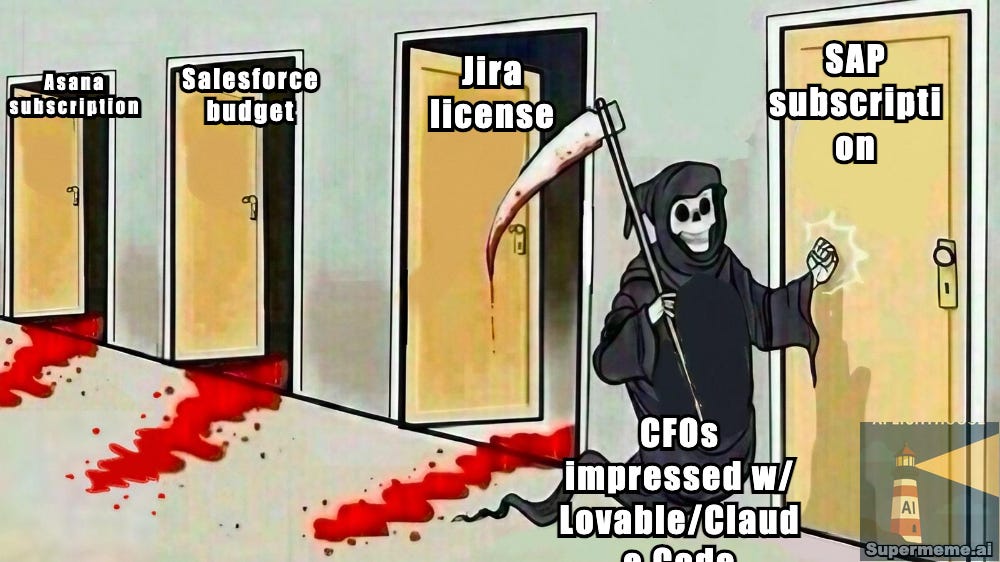
They wanted to start by replacing Asana. In their minds, Asana was simply a task board and therefore one of the easier applications to recreate.
But that view misses what Asana really is.
Asana represents more than 15 years of accumulated knowledge about how organizations coordinate work. Its superpower isn’t the code itself—it’s the thousands of product decisions, workflow rules, and edge cases distilled from observing millions of users across thousands of organizations over many years.
Everything from task ownership and permissions to dependencies, notifications, recurring workflows, and project templates has been refined through relentless real-world usage. Individually, each of these problems appears straightforward. Collectively, they represent a vast body of encoded organizational knowledge that is extraordinarily difficult to recreate.
To be sure of the ask, I asked:
“Your company also sells software. By that logic, wouldn’t your customers eventually think the same way and replace your software as well?”
The response was immediate:
“No. Our strength isn’t the software. It’s the data that lives inside it and the competitive intelligence we provide on top of it”
What they failed to realize was that the same logic applies to many of the products they were hoping to replace. They saw them as mere software. In reality they are much more than that.
To make the point clearer, I asked:
“Do you also plan to replicate LinkedIn?”
The answer came without hesitation:
“Why not?”
And that’s when the misunderstanding became obvious.
The LinkedIn Example
Most people think LinkedIn’s value comes from its software. It doesn’t.
Others assume its moat comes from the user data it has accumulated over the years. That’s not quite right either.
According to one estimate, LinkedIn has roughly 1.3 billion registered users spread across more than 200 countries, with hundreds of millions of active users every month. But the real asset isn’t the users themselves—it’s the relationships and interactions between them.
Think of LinkedIn as a giant professional graph. Every connection between two professionals is an edge in that graph. Collectively, those connections add up to hundreds of billions of edges.
Now imagine launching a LinkedIn competitor called ProfessionalGraph. Suppose you somehow convince 10% of LinkedIn’s active users to join. That sounds impressive.
Unfortunately, you won’t get 10% of LinkedIn’s value.
You may not even get 3%.
Why? Because the overwhelming majority of professional relationships still remain on LinkedIn. The graph fragments. The network weakens. The value evaporates.
Unless you can trigger a mass migration overnight—a Facebook-over-Orkut-style event—your new platform is unlikely to gain meaningful traction.
This is what makes LinkedIn difficult to replicate. Not the code. Not even the data. The real moat is the network itself.
Let’s look at this more closely.
As the professional network of the world, LinkedIn would love to know the skills possessed by every individual on the platform. Such information would be immensely valuable. But how do you collect it?
Simply asking users to list their own skills creates a quality problem. Most people would naturally be inclined to present themselves in the best possible light, making the resulting skill graph noisy and unreliable.
LinkedIn’s solution was clever. Instead of asking users to validate themselves, it asks others to endorse them. If enough people endorse Person A for Skill S, the probability that Person A genuinely possesses that skill increases significantly. The resulting skill graph may be sparse—only a small fraction of users actively participate in endorsements—but it is far more trustworthy than self-reported data.
What’s important here is that this information does not exist in isolation. It emerges from the underlying professional network. The value comes not just from the nodes (people) but from the connections and interactions between them.
That’s the central point.
The true power of LinkedIn comes from the massive interconnected graph that captures real-world professional relationships, trust signals, endorsements, career histories, and interactions.
Replicating the software is relatively easy. Replicating that graph is extraordinarily hard.
And that graph—not the code—is LinkedIn’s moat.
Software Products are Much More Than Code
As many experienced software professionals would probably guess, I didn’t take the project.
The last I heard, their internal engineering team was still pursuing the initiative, with the CTO actively championing it. The CXO is still hoping to save $15-20M. Perhaps they’ll succeed. Perhaps they’ll learn some expensive lessons along the way.
But their assumption highlights a common misconception about AI-powered software development.
Tools like Lovable, Claude Code, Codex, Cursor, Ema, and others have undeniably transformed software engineering. They can dramatically reduce development time and, even more importantly, lower the technical barrier to entry.
Today, someone with little or no software background can build a functional application in a matter of hours. A retired pizza shop owner could create a basic ordering app for local customers without writing a single line of code.
That is genuinely remarkable.
But here’s where many people go wrong.
They assume that building an MVP and building a production-grade software product are essentially the same thing.
They are not.
To a non-technical person, software is the visible functionality on the screen, and implementing that functionality appears to be the hard part.
To an experienced engineer, the visible functionality is often the easy part.
The real challenge begins after the prototype works.
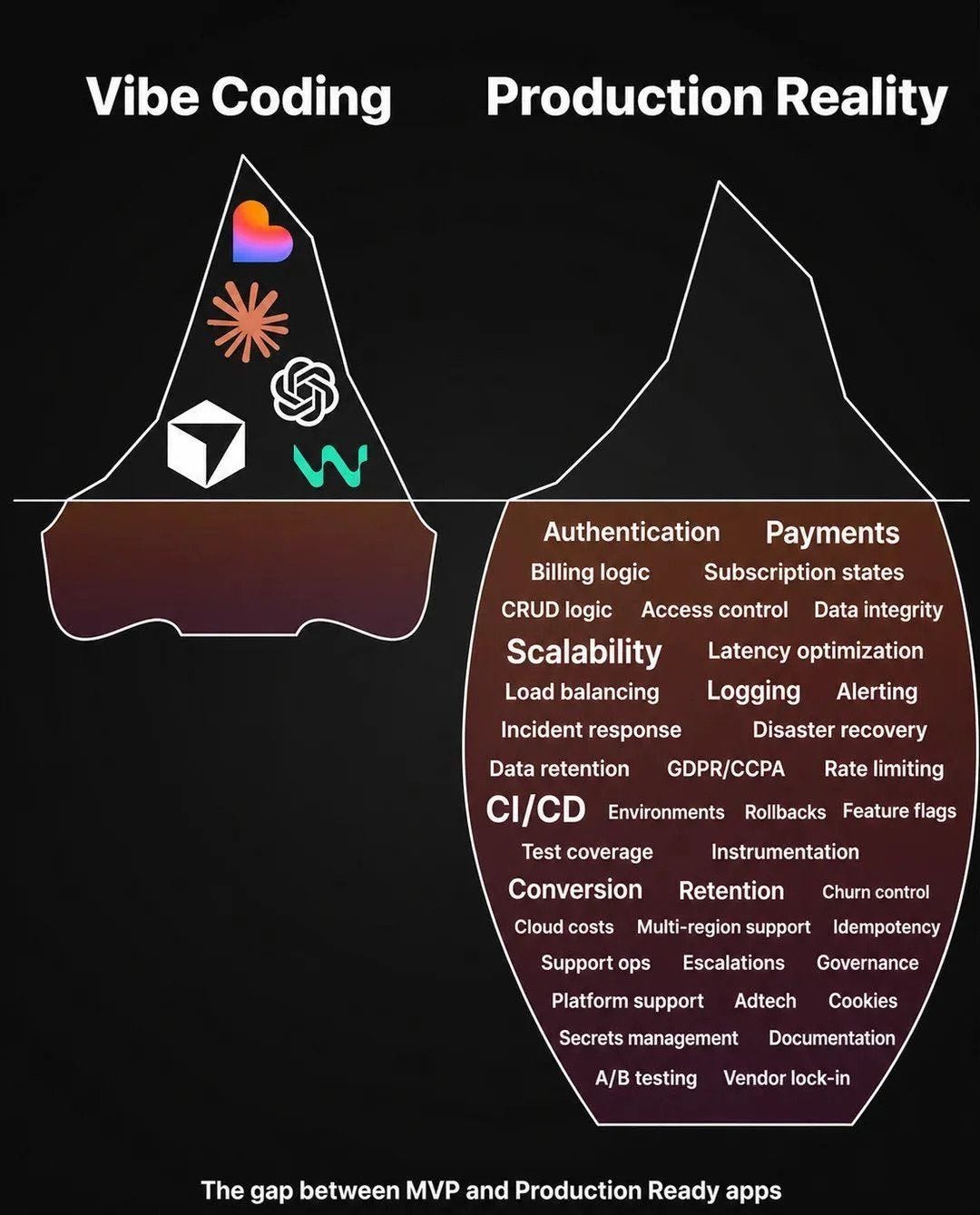
A production-grade software product requires far more than a collection of features:
Authentication and authorization
Payments and billing
Scalability
Reliability
Security
Monitoring and observability
Compliance
CI/CD pipelines
Data governance
Backup and disaster recovery
Performance optimization
User acquisition and retention systems
Third-party integrations
These are the things that separate a weekend prototype from a product seamlessly serving millions of users.
The CXO’s expectations were disconnected from this reality.
Just because you can build a concept car for an auto show doesn’t mean you can drive it from New York to California.
The same principle applies to software.
Building a demo is easy. Building a reliable product that survives real-world usage is an entirely different challenge.
The difference is best illustrated in the figure below.
The Hidden Cost of “Building Everything Inhouse”
Many executives assume that even if they can’t perfectly replicate commercial software, they’ll still eliminate a large portion of their software spending.
Not necessarily.
Building & Running production software is a very different beast from building an MVP. It is neither easy nor cheap.
What happens when the system crashes?
What happens when a critical security vulnerability is discovered?
What happens when regulations change?
What happens when an essential workflow stops working at 2 a.m. on a Sunday morning?
These problems don’t disappear simply because the software was built faster.
When you buy software, you’re not just buying code.
You’re buying years of maintenance, bug fixes, security patches, reliability engineering, customer support, operational processes, and institutional expertise.
In many ways, you’re buying an entire organization standing behind the product. and thats what you for!
This is one of the primary reasons large enterprises often choose commercial software over open-source alternatives, even when the open-source version is technically equally or sometimes much more capable. The software may be free, but operating and supporting it at scale rarely is.
There’s another issue that doesn’t receive enough attention.
We still don’t fully understand the long-term consequences of AI-generated code at scale.
What kind of technical debt are these systems creating?
How maintainable will large AI-generated codebases be five years from now?
What happens when the engineers who originally prompted the code are no longer around?
The honest answer is simple:
Nobody yet knows. These are early days of AI powered SDLC
We’re still in the early innings of this experiment.
The situation reminds me of hosting a wedding banquet for 500 guests.
Just because robots can help cook doesn’t suddenly make it sensible to prepare the entire meal yourself instead of hiring professional caterers.
The robots may reduce some of the labor.
But you’re still responsible for procurement, planning, quality control, hygiene, logistics, serving, and ensuring that dinner is actually on the table when 500 hungry guests arrive.
Software is no different.
AI may be (today) dramatically reduce the cost of writing code. It does not eliminate the cost of owning, operating, and supporting a production system.
AI-Powered Development Isn’t Cheap or Free
There’s also a growing myth that AI-powered software development is cheap and with time will become even more cheaper. Highly unlikely. Rather it is likely to become far more expensive. The economics are more complicated than most people realize.
Recently, Uber’s CTO mentioned that the company’s annual Engineering budget was exhausted within just a few months. Today, AI powered SDLC tool providers continue to heavily subsidize usage to accelerate adoption & capture large share of the market. Today’s pricing structures are unlikely to represent the true medium-to-long term cost of these systems.
Ironically, in many scenarios, human developers remain cheaper than people assume. Will that change in the future? Possibly. But it requires AI costs to fall dramatically while capability continues to improve. That’s not guaranteed. On the contrary, it might only go up. (I will be writing a separate blog on this)
So What’s the Real Value of Vibe Coding?
This doesn’t mean vibe coding is overhyped. Far from it. It is one of the most important shifts in software creation we’ve seen in decades.
But its biggest impact isn’t where most people think. Its superpower is Minimum Viable Product (MVP) creation. Building a MVP has changed forever.
A CTO no longer needs to spend days explaining what he wants or writing requirement documents before validating an idea.
A product manager no longer needs to rely solely on PRDs, mockups, and wireframes to communicate intent. Instead, they can build a working prototype. This is the new PRD. PPTs for project proposal are now replaced by vibe coded MVPs.
A founder can test a market opportunity very quickly without building product or before raising capital. A designer can demonstrate a user experience instead of describing it. An internal team can validate assumptions before committing engineering resources. When it comes to software development, the distance between an idea/vision and a working prototype has collapsed. Being able to vibe code an MVP is now a must have skill for every professional, no matter which function you are part of.
If you like building applications for fun but does not have the technical background for it, then vibe coding is a great equalizer. For example: in some countries whatsapp is very popular messaging app. People promise each other to sending a file, reminder, calendar invite etc etc but then forget it. Someone made a simple app “Commit” for this. Commit enhances your WhatsApp usage by finding commitments automatically — things you said you’d do, and things others said they’d do. It auto detects when things are done. When something goes quiet, it surfaces it for follow-up. To vibe code this, having a deep background in CS or software engineering is not must. A builder mindset is must. Even a 70 yrs old retired farmer can do this.
That is the real revolution.
Not replacing every software company.
Not rebuilding LinkedIn.
Not eliminating engineering teams. (will address this in detail in another post)
The winners won’t be the organizations that use AI to recreate existing software. The winners will be the organizations that use AI to validate, iterate, and learn faster than everyone else.
Think of ultra smart growth hackers, Chief of Staffs, Marketing & sales folks - they quickly vibe code MVPs & variants to test their hypothesis & market, without being dependent on engineering team’s bandwidth. This will unlock a new breed of growth hacking. In the valley, vibe coding has already become a must have skill for these folks.
Another major unlock with be data products & applications for data collection. More on this in the next blog.
If you use this post in part or in full, please do cite this write-up as:
Gupta, Anuj. (May 2026). Vibe coding, AI Powered SDLC - Advantages & Misconceptions. anujgupta.co https://pragmaticai1.substack.com/p/vibe-coding-ai-powered-sdlc-advantagesor
@article{gupta2026vibeCodingPart1,
  title   = {Vibe coding, AI Powered SDLC - Advantages & Misconceptions},
  author  = {Gupta, Anuj},
  journal = {anujgupta.co},
  year    = {2026},
  month   = {May},
  url     = {https://pragmaticai1.substack.com/p/vibe-coding-ai-powered-sdlc-advantagesor}
}